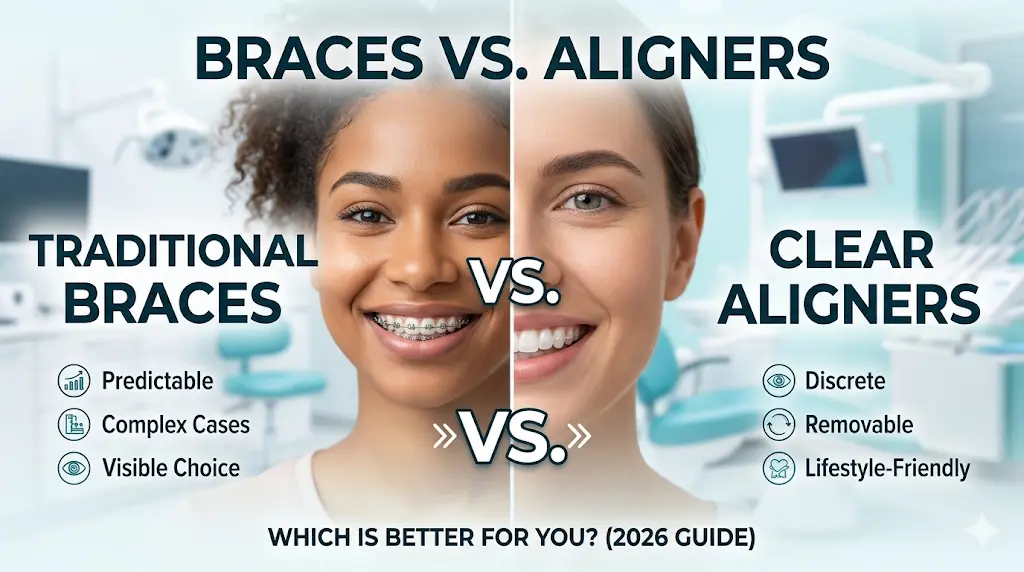
The debate between traditional braces and clear aligners is the most common conversation in modern orthodontics. Deciding which is 'better' is entirely subjective; it depends heavily on your specific clinical complexity, budget, lifestyle, and most importantly, your honest ability to wear removable aligners consistently. Both options are highly advanced in 2026 and can deliver phenomenal, life-changing results when supervised by an experienced clinician. If you are already leaning toward a decision, you can explore the full orthodontics and aligners service at our Chandigarh clinic or keep reading for the breakdown.
Quick comparison overview
- Clinical Effectiveness: Braces remain the highly versatile gold standard for complex, unpredictable tooth movements. Aligners excel at mild to moderate corrections and pre-planned aesthetic alignment.
- Daily Appearance: Aligners (like Invisalign) win easily for near-invisibility. Ceramic braces offer a discreet fixed option, but the wire is still somewhat visible.
- Typical India 2026 Cost Ranges: Traditional metal braces average Rs 30,000 to Rs 80,000. Aesthetic ceramic braces range Rs 60,000 to Rs 1.1 lakh. Premium clear aligners range significantly from Rs 60,000 to over Rs 3.5 lakh depending on the brand and case length.
- Treatment Duration: Depending on case severity, either method generally takes between 6 to 36 months.
When traditional braces are usually the better choice
Despite the popularity of invisible options, fixed braces are often the clinically superior choice for severe crowding, extreme tooth rotations, significant vertical movements (like pulling an impacted canine down), and major bite corrections (overbites, underbites). Because the brackets are permanently glued to the teeth, the orthodontist has 24/7, 3D control over the root movement.
Furthermore, braces are the best choice for patients—especially teenagers—where compliance is a known issue. If you know you will forget to put removable trays back in after every meal, fixed braces at our Chandigarh orthodontic clinic guarantee the treatment is constantly working.
When clear aligners are usually the better choice
Clear aligners have revolutionized orthodontics, especially for adults who previously refused treatment due to the aesthetic stigma of metal brackets. They are highly suitable for mild to moderate crowding, closing minor gaps, and orthodontic relapse (people who had braces as kids but didn't wear their retainers).
The biggest clinical advantage is hygiene. Because you remove the aligners to eat and brush, you can maintain perfect oral hygiene without navigating around wires. However, their success relies entirely on the patient's discipline to wear the trays for the required 20 to 22 hours every single day. If you are already doing aligners and wondering about the full smile picture, explore our smile makeover guide for Chandigarh which covers how aligners fit within a complete aesthetic plan.
Lifestyle Impact: Diet and Comfort
With fixed braces, your diet must change. You have to avoid incredibly hard, sticky, or chewy foods (like whole apples, hard nuts, or caramel) that can snap a wire or pop off a bracket, leading to emergency clinic visits. Braces can also cause temporary soft tissue irritation (mouth sores) on the cheeks and lips.
Aligners offer dietary freedom—you eat whatever you want because the trays are out. However, you must commit to brushing your teeth and cleaning the trays after every single meal or snack before putting them back in, otherwise, you trap sugars against your teeth, massively increasing cavity risk. Aligners may also cause a slight, temporary lisp for the first few days as your tongue adjusts.
Cost, follow-ups, and the reality of compliance
Aligner pricing in India varies wildly right now. Lower-cost, direct-to-consumer options often involve far less direct clinical supervision. Premium, globally recognized systems (like Invisalign) are more expensive but include detailed, orthodontist-led digital planning and reliable proprietary plastic materials.
With braces, you usually visit the clinic every 4 to 6 weeks for wire adjustments. With aligners, visits might be less frequent (every 8 to 12 weeks), but you are responsible for switching to the next tray at home on schedule. Non-compliance (not wearing the trays enough) is the number one reason aligner cases get delayed, require mid-course corrections, or ultimately fail.
Local care coverage
We proudly provide comprehensive orthodontic care for patients across Chandigarh, Mohali, Panchkula, Zirakpur, and Kharar. Whether you prefer reliable fixed metal appliances, aesthetic ceramics, or a digitally supervised clear aligner workflow, we tailor the plan to your life.
Quick next step
Bring your recent OPG x-ray or let us take intraoral photos to show you a 3D digital treatment simulation and provide a highly personalized cost plan.
Internal links
FAQs
Are clear aligners really as effective as traditional braces?
For mild to moderate cases, yes, they can be equally effective and highly predictable. However, for severe skeletal discrepancies or complex root movements, fixed braces still offer the orthodontist significantly more control.
Which option costs more in clinics in India?
Generally, comprehensive clear aligner therapy is priced higher than basic metal braces, especially if utilizing premium global systems. However, indigenous Indian aligner brands are bringing the cost closer to ceramic braces.
Is it too late for adults to get braces?
Absolutely not. Adult orthodontic treatment is incredibly common today and highly predictable. While tooth movement can be marginally slower due to denser adult bone compared to teenagers, the aesthetic and functional benefits are identical.
Which treatment is faster, braces or aligners?
Neither tool is universally faster. The speed of treatment depends entirely on the specific movement goals, the biological response of your bone, case complexity, and crucially, your daily compliance with instructions.
Are cheap at-home mail-order aligners safe to use?
They carry significant risks. While they may move teeth in very simple cases, without direct, in-person supervision and proper x-ray evaluation by a dentist, moving teeth can cause irreversible root damage or severely alter your bite.
Conclusion
Ultimately, there is no single 'best' orthodontic option for everyone. The right choice is a balance of your clinical complexity, your financial budget, and an honest assessment of your daily lifestyle habits and compliance.
A thorough clinical assessment by a specialist, combined with modern digital planning, is the only way to get a truly accurate recommendation for your smile. Once your teeth are aligned, many patients then explore options like porcelain veneers or a smile makeover to complete their aesthetic transformation.